
It is a common and big misconception that cloud networking is the next stage in the development of traditional IT networking. It implies continuity, as though the fog only enhanced what was already in place. In reality, cloud networking is based on a separate set of beliefs, and such assumptions completely change how networks function, are constructed, and interact with engineers.
Traditional Cloud Networking
Traditional networking grew out of a world where everything was more or less steady. Servers were sitting in a data center, clearly placed and easy to account for. Network didn’t really change unless someone went in and changed it on purpose, and even then, it was a planned process.
Cloud networking doesn’t work like that, because nothing really stays in one place for long. Infrastructure is virtual, services can appear or disappear depending on demand, and the whole system is constantly adjusting itself in the background without anyone manually moving things around.
This difference is not on the outside, but it’s inside. Because it affects everything from routing decisions to security models, from scalability to system reliability. If you really want to understand why cloud networking requires a different approach, it is necessary to look at how it behaves in real operational environments. And, well, not how it is described in abstract terms.
Why “Location” No Longer Has the Same Meaning in Networking?
One of the more subtle changes in cloud networking is that location becomes less useful as a way to understand how systems behave. In older setups, knowing where something physically ran often told you a lot about its performance, its dependencies, and even its risks. Network design often concentrated on reducing distance because it was a pretty direct factor.
That relationship begins to worsen in cloud settings. A service’s “close” or “far” status is not a fixed feature connected to hardware location or geography anymore. Even if two requests from the same user occur seconds apart, they may not take the same route.
Because of this, networking becomes more like dealing with a system that continuously redraws its own map in the background than it is like creating a map. Engineers must consider behaviour patterns and probabilities, where the path is always conditional rather than fixed.
The Change to Shared Infrastructure Models from Hardware Ownership
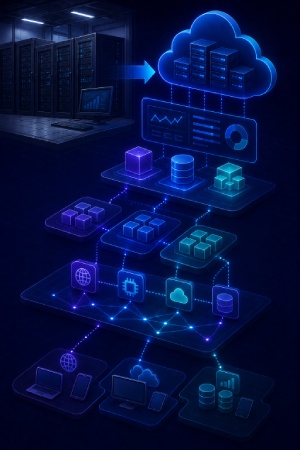
The loss of direct control over infrastructure is another big shift that comes with this change. In on-premise setups, companies had their own hardware and handled everything themselves, from planning how much capacity they needed, to tuning performance, to rolling out updates. Everything stayed in-house, and teams could clearly see and manage how each part of the system was working.
Infrastructure now is a shared resource under the provider’s management in cloud environments. This indicates that control is communicated differently, but it does not mean that systems are less powerful. Teams specify the performance, availability, and scalability characteristics they require, while the underlying system divides resources in accordance with those specifications.
This also changes who is responsible for what. Some parts of reliability and performance depend on broader decisions made by the cloud platform itself. Because of this, developers don’t spend time tweaking every individual component anymore.
The design of systems is completely changed by this abstraction. A server is no longer a fixed object placed on a rack. It is a temporary form that might last for a few minutes, hours, or days before being moved or replaced. Instead of being limited to specific locations, applications function in dynamic environments that are always changing.
Cloud systems typically center around a few key concepts rather than physical infrastructure:
And then, the result of networking is managing relationships between abstract services.
Systems Meant for Constant Movement Rather Than Fixed Setups
Old-school networks were pretty fixed because once they were set up, they usually stayed that way for a long time, and people only touched them when something actually needed to change.
Cloud systems don’t really work like that, since nothing stays still for long. When demand goes up, more resources get added automatically, and when things slow down, they scale back on their own. Even running services can move around in the background depending on what’s faster, cheaper, or more beneficial at the moment.
Even the basic infrastructure can change without anyone noticing. A virtual machine might run on different physical hardware at different times, but the application still sees it the same way.
Because of this, you cannot really assume things will stay stable anymore. In cloud systems, change is normal, not something unusual.
That is why cloud networking has to be built differently. It basically needs to adjust as things happen, find resources automatically, and redirect traffic whenever needed.
What Actually Happens When You Load a Website?
From a user’s point of view, loading a website feels instant and simple. You open a browser, type in a web address, hit enter, and the page shows up. That’s it. But behind this one thing, a lot more is happening than most people would expect.
The first step is DNS, which is basically the system that figures out where the website actually lives. In older, traditional setups, you type a domain name, and DNS returns a fixed IP address tied to a specific server.
In cloud environments, it’s easier than that. Because DNS doesn’t just return a single static answer anymore, and it can take a few things into account before deciding where to send you, such as:
Because of that, two people opening the same website at the same time can end up being sent to completely different servers, depending on what the system thinks is the best option at that moment.
Getting a Response to the Right Place at the Right Time
If the request can’t be answered from a nearby location, it continues to the application itself. Before it gets there, the system decides which available server or application instance should handle it. That decision depends on what’s happening at that moment, such as current traffic levels or server health.
Developers often design applications so that different parts handle different tasks. Because of this, even a simple action from a user can set several things in motion behind the scenes. Opening a dashboard or viewing a product page may require information from multiple systems before everything can be displayed on the screen.
What Is the Real Design of Cloud Networking?

There isn’t actually a specific shape for cloud networking. Imagine it like a chain of independent pieces, each of which transfers tasks to the next.
From Actual Devices to What Users View
The physical computers and data centers that run everything in the background are located at the bottom. Since the supplier takes care of everything, most consumers never have to deal with this directly.
Additionally, such physical resources are transformed into adaptable virtual ones. You operate with versions that can arise when needed and vanish when not, as opposed to fixed computers.
Then, without anyone needing to consider wires or hardware, there exist rules that govern how objects connect to one another.
Above that (despite changes underneath), systems handle the flow of traffic between services, ensuring that requests always end up where they should.
Methods for Getting Traffic to the Right Place in Real Time
In cloud networking, the system decides in the moment where each request should go, based on what’s happening right then.
Also, it constantly reacts to changing conditions. But what does the system look at when making decisions?
| Health of the server | Only working, responsive servers get traffic |
|---|---|
| Current load | Requests are avoided on already busy systems |
| Response speed | Faster options are preferred when possible |
| Location | Requests are usually sent to the nearest available place |
| Availability | Non-working or not so stable services are automatically avoided |
Traffic is always rearranged because of these. If it begins to slow down, something silently receives less traffic. And requests are spread to different locations if one region is overwhelmed, without anyone having to make any manual changes.
How Do Cloud Systems Adjust to Demand in Real Time?
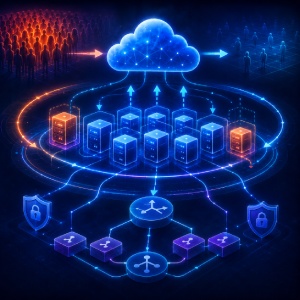
Scaling in the cloud is very different from how it used to work. In older systems, scaling was something people had to do by hand. Engineers tried to predict how much traffic was coming, prepared extra servers in advance, and then added them when things got busy. It worked, but it was slow and always a bit behind reality.
Scaling Without Waiting
In cloud environments, scaling happens on its own and all the time. When traffic goes up, new instances are created automatically. When traffic drops, some of them are removed. This keeps happening in real time based on constant monitoring.
But servers are not the only factor, since the network must also stay up to date. Security rules have to be effective immediately, load balancers must update the destinations, and new instances must be connected to routing systems. So everything works like a loop.
Why Do Modern Apps Create So Much Internal Traffic?
Cloud applications today are often split into smaller parts, so they are not one big system. Each part has a specific job, like logins, payments, user data, or notifications. This makes things easier to build and maintain, but it also means that one simple user action can set off a lot of communication inside the system.
What looks like one click or one request from the outside can actually involve several steps behind the scenes. One part of the system passes the task forward, and something else picks it up. Because of this, the connections between services become just as important as the connection between the user and the app. And users will definitely notice a slowdown in the entire process if there are even slight delays.
Reasons Cloud Security Doesn’t Use Fixed Perimeter Anymore
It’s not a surprise that in older systems, security was pretty simple. If something was inside the network, it was usually trusted. If it came from outside, it was treated with caution. But the difference between inside and outside is not always so obvious in cloud systems. It is impossible to consider any one location to be safe, just because people connect from a variety of locations. So all in all, trust cannot be based on the source of a request.
Instead, every request has to prove who it is and what it’s allowed to do, no matter where it shows up from. Security is also not handled in one single place. It’s built into different parts of the system, and a lot of communication between services is protected automatically in the background. Well, it makes things more secure overall, but it also means the system has more moving parts that need to work together.
What Actually Happens When Something Breaks in Cloud Systems?
One of the key differences in cloud networking is how normal it is for things to go wrong and still keep working. In older systems, problems were often contained. If a server failed, usually only that part of the system was affected, while everything else kept running as usual.
Luckily for everyone, failures are not considered rare situations in cloud environments. They are expected because the system is designed to handle them automatically.
If something stops working properly, it’s simply taken out of rotation and replaced, and that’s it. If an entire region has issues, traffic is moved somewhere else. Because of this, the system is always prepared for parts of it to fail at any time. Of course, it doesn’t assume everything will stay perfect, but it assumes things will break, and it’s designed to keep going anyway.
How Cloud Systems Deal with Problems Without Anyone Noticing?
You know, cloud systems are constantly checking themselves in the background. Don’t think anything dramatic, it’s more like a question. “Is everything still okay?” So it checks like this all the time.
And it’s not waiting for a human to step in, because the system reacts on its own as soon as something starts looking off.
- If a service gets slow or stops responding properly, it’s quickly flagged
- Traffic is quietly moved away from anything that doesn’t behave well
- New copies of a service can be started elsewhere if something fails
- Whole regions are also watched, not just single servers
In practice, this means problems are often handled before they turn into something visible. If something starts slowing down, it just gradually gets less traffic. If it completely breaks, it’s swapped out. And if a whole area starts performing worse, users are slowly redirected somewhere else.
Why Cloud Networking Works Differently?
So all in all, cloud networking works differently from older systems because the environment itself is different. Traditional networks were built around fixed machines, and most things stayed stable unless someone changed them. In cloud environments, services can move, or even be replaced, while the system is running. Access is basically regulated by identification and not physical location, and traffic decisions are made in real time depending on current conditions. All of this results in a system that just works better for everyone that matters most.