
The advent of cloud computing has revolutionized how companies manage applications, data and digital services. Instead of utilizing a single supplier for all of an organization’s technology needs or running everything internally (on premises), most organizations today utilize multiple cloud providers at the same time. This is known as a “multi-cloud” model which enables organizations to be more flexible, reduces reliance on a single vendor, and distributes workload across multiple systems.
Although using a multi-cloud strategy provides additional operational benefits it creates new security issues. Each cloud provider has their own unique architecture, access controls, management tools and security policies. When you add two or more systems into your environment managing security becomes much more complicated. Your team will need to protect applications, track traffic, manage identities and implement policies across systems that were not originally designed to function together.
Multi-cloud security problems usually don’t stem from just one issue. Problems develop due to poor visibility, lack of integration between various management tools and increasing complexity in the infrastructure. The more cloud-based services you have operating within an organization, the more difficult it will be to provide a safe and controlled environment through traditional network perimeter concepts.
What is Multi-Cloud Infrastructure?
An environment using services from more than one cloud provider is considered a multi-cloud environment. Organizations can utilize one or more public cloud service providers, private clouds or on-premises solutions dependent upon business and technical needs.
Many organizations choose a multi-cloud model because they want to minimize the amount of money spent on one specific vendor. Some organizations move their workloads to other environments dependent upon such factors as; cost, performance, regional availability, regulatory compliance, etc.
Hybrid Environments
In addition to public and private clouds there are hybrid clouds. A hybrid cloud uses both on-premise infrastructure and off-premise (public) cloud services. An example would be to run some of your critical internal system(s) on premise but utilize cloud resources when needed for scalability or disaster recovery purposes.
While this type of model does help organizations gain greater flexibility and options for where they place certain workload(s); the increased number of separate systems/infrastructure makes the job of managing security across those platforms more challenging.
Identity and Access Management Challenges
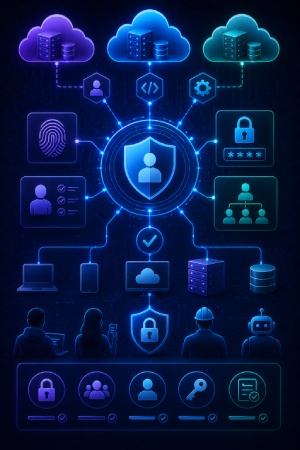
Multi-cloud infrastructures elevate identity management to one of the most important security risks. Modern cloud systems depend on identity-based access management instead of access control by segmentation per network zone. Users, applications, services, and devices all require managed access to cloud resources.
In multi-cloud environments, divergent authentication methods, permission models, and identity management systems lead to operational difficulties for security teams, as they strive for uniform access policies.
Suboptimal identity management increases exposure to access risk, credential misuse, and privilege escalation. Over time, organizations become burdened by unnecessary accounts, excessive permissions, and inconsistent role assignments.
The problem worsens when remote work, third-party contractors, and automated services are factored into the management system. Every user and application increases the exposure via access points.
The goal of identity management is to mitigate risk to the greatest extent possible. Some common practices include:
- Multi-factor authentication is an improvement to traditional password-based systems.
- Role-based access control is when permission assignments are based on the user’s role.
- Centralized identity management is when a system is put into place that is used by all of the cloud providers.
- Single sign-on is a system used to sign into multiple services or applications.
- Access reviews are periodic assessments of permission assignments.
Implementing these systems help to protect organizations from exposure to access-related credential threats.
The Complexity of Hybrid Cloud Security
The advantages of hybrid cloud are also accompanied by some security risks: Organisations have to deal with the security of both the cloud services and on-premises systems. They typically are a blend of legacy apps, cloud native services, and third party integrations.
Older solutions may not have been designed for a distributed cloud application. Their poor integration with current cloud services can lead to visibility issues and disjointed security policies.
Also, data movement across environments makes things more complicated. While regular usage, applications will share data with private servers and public cloud services multiple times. There is an added level of security for each piece of connection.
Security teams need to ensure consistency within the environments for the following security policies: encryption, authentication, and monitoring. If centralized control or supervision isn’t in place, hybrid systems can become unwieldy and fragmented in nature.
Manually mis-configured clouds are especially prevalent in hybrid deployments. Inadequate storage rights, unsecured APIs, and unsecured management interfaces could leave room for vulnerabilities that attackers could exploit.
Network Segmentation and Isolation of Applications
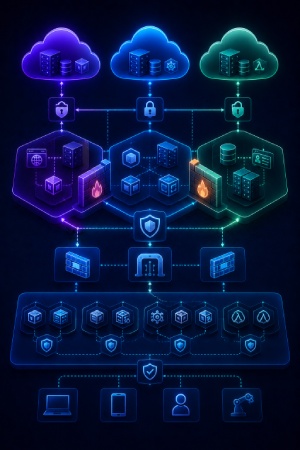
Application segmentation is key in lowering risk in a multi-cloud environment. Segmentation is the process of directing workloads, services and network resources to contained environments instead of free-flowing across the infrastructure.
Traditional data centres relied on a network segmentation strategy via network boundaries and firewalls. Cloud stores present new challenges; cloud apps run dynamically on distributed systems, therefore more granular approaches are needed.
If the systems are not segmented, then exploiting one system could give the attacker the opportunity to move to another system. This makes security breaches have a greater impact.
A strategy to achieve microsegmentation in cloud security is gaining traction. While most networking solutions achieve broad networks, microsegmentation assigns security policies to workloads and applications.
Here are a number of segmenting methods that minimize exposure:
- Isolating workloads stops unnecessary communication between unrelated applications spanning cloud environments.
- Network segmentation restricts the flow of traffic from sensitive systems to public-facing services.
- Microsegmentation is the application of security controls to workloads, containers, or application components directly.
- API gateways can be used to control and secure communication between services that are distributed.
- Security groups and internal firewalls limit traffic according to a set policy or rules on behaviour.
These measures minimize the risk of an isolated system having an impact on the whole network.
Zero Trust Networking: The Emerging Trend
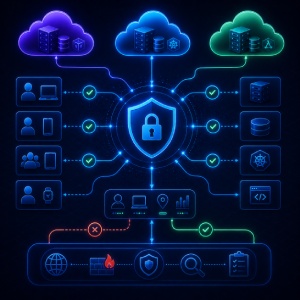
Traditional security models have implied that systems within a corporate network were trusted systems that could be assumed to be safe. With the increasing adoption of multi-cloud setups, this approach is becoming less effective due to the use of multiple applications and locations and multiple devices.
Zero-trust networking (ZTN) has arisen as another solution to the problem. The zero trust model takes trust on location as the starting point, meaning that no user, device or service is given trust by default.
Rather, each request should be checked on-the-fly by analyzing identity, context and behaviour. Several criteria, such as users’ identity, device health, geographical location and workload behaviour are used to determine access.
A zero-trust approach minimizes the threat of compromised credentials and insider attacks because they can be accessed sparingly and are constantly watched.
In many modern zero trust systems, these technologies are combined as a whole into a single security solution, be it bundled into a single service, deployment service, etc., or a framework that supports the integration of one or more of the various components.
Secure Access Frameworks in Distributed Environments
To ensure secure access to cloud resources, there are security access frameworks to ensure the management of users and systems. Traditional VpN models are not practical in large-scale cloud scenarios as remote working and distributed operations grow in popularity.
SASE, or Secure Access Service Edge, is emerging as one type of new approach for a distributed infrastructure. SASE integrates network and security capabilities in a cloud-based offering to enable remote access and apply policy enforcement.
Secure access frameworks dynamically assess connections and deploy security targets more locally to users and applications, rather than in a centralized corporate network. These models can be made scalable and offer secure remote access across different cloud platforms.
Security frameworks are also a key part of observability systems, giving more visibility of user activity, network behaviour and application interactions at any time.
Threat Detection for Multi-Cloud Systems

Threat detection gets harder as the cloud environment widens its reach from a single cloud to many clouds and across multiple geographic regions. All of the platforms produce their own logs, metrics, security alerts, etc. If there is no centralized visibility, detecting suspicious activity is much more difficult.
Security teams need to gather and research data from a variety of sources at once. This includes activity in the cloud, API requests, application events as well as network traffic.
To sense threats, modern threat detection systems rely more on automation and artificial intelligence algorithms that analyse data in real time from operational systems. These systems can also detect unusual patterns that could point to a compromise of credentials, malware activities or attempts at unauthorized access to the system.
Vital also is behavioural analytics. Behavioural systems recognise abnormal behaviour identified by variations in how a network system operates compared to the norm, rather than attacking specifically known signatures.
Real-time monitoring enables enterprises to “act fast before act”, combat new threats, and have a lower damage possibility.
Cloud Misconfigurations and Human Error
One of the top reasons for incidents in the field of cloud security remains due to human error. When applications rely on multi-cloud, there are more chances for configuration errors to occur and for teams to have a distributed footprint between multiple clouds.
The interfaces, terminology and configuration models are different for each cloud provider. Security teams could inadvertently have different policies in place between their environments.
Common wrongly configured applications are publicly accessible storage buckets, with too many permissions given, unsecure APIs, or not well-configured databases. These weaknesses can reveal a sensitive and significant amount of information despite the underlying cloud infrastructure being secure.
These risks can be mitigated through the use of automation: Standardising deployments and enforcing policies. However, configuring automation systems is important, too, so as to not introduce errors in the process when implemented at scale.
Real time configuration monitoring is an emerging requirement in Cloud Security Operations. By finding policy violations and vulnerable resources before attackers do, automated scanning tools can help you achieve this goal.
Data Protection and Compliance Challenges
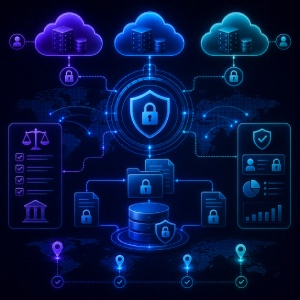
With information provisioning across multiple cloud providers and geographical regions, data protection is more complex. Organisations are responsible for ensuring the security of sensitive data wherever is it stored and processed.
Encryption is a significant feature of cloud data protection and is one way organisations ensure the security of sensitive data. Clouds usually encrypt information in transit and while in storage.
There are compliance needs added as well. Industries/regions have specific regulations and directives on access, retention, and privacy of data. In order to address these requirements on a consistent basis multi-cloud environments need to be designed carefully.
The ability to clearly see the location of data and how it flows through infrastructure is also crucial for organisations. If left unchecked, compliance threats can grow extremely high.
The Operational Burden of Multi-Cloud Security
It takes a lot of operational coordination to manage security across distributed cloud infrastructure. Each team will have to keep an eye on several dashboards, adhere to policies, and react to notifications sent from different locations.
This complexity can lead to fatigues in operations. Security notifications can inundate teams, leaving them with a difficult challenge of identifying quickly true threats in today’s environment.
The apparent lack of skills also adds to the difficulty. Securing cloud applications demands a level of expertise with networking, zero identity management, automation of infrastructure, and application security all at the same time.
Various security functions are now typically all integrated in a single central management platform to minimize the fragmentation that may exist in several organisations. These systems can enable service-CI integration, policy self-reconciliation and ease the way of cloud ops.
The importance of security automation is increasing, too. Manual processes face threats and configuration issues sluggishly, while an automated remediation system can get onto the job sooner.
Practical Guidance for the New Multi-Cloud Security Landscape
The use of cloud will continue to grow and the concept of multi-cloud security strategies will become increasingly complex. Companies are now adopting more sophisticated means of automating processes and implementing Artificial Intelligence and centralized management systems to streamline operations.
Zero-trust Architectures are expected to be increasingly rolled out alongside the shift from a perimeter security to a non-perimeter security approach. Access management will involve the growing use of identity verification and behavioural analysis.
Security platforms are evolving quickly too, in this case cloud-native ones. The observability of the system, threat detection, policy enforcement, and compliance management are increasingly being implemented together in systems as one single framework.
Meanwhile, these attackers still go to great lengths to attack distributed cloud systems. Security must be flexible, adjustment must be made all the time as per evolving risks.
A Smarter Path to Secure Multi-Cloud Operations
Multi-cloud infrastructure is an agile, scalable approach that delivers operational resilience and flexibility to today’s modern businesses. It presents significant security challenges as well, though, that must be addressed carefully and continually.
There are several key components that help ensure security of distributed environments including identity management, application segmentation, threat detection systems, secure access frameworks, and zero-trust networking. As cloud environments become increasingly interconnected, the need to keep track of them and to ensure consistency of policy grows in significance.
Companies that adopt centralised management, automation, and flexible security architectures will be more equipped to tackle the challenges of today’s complex cloud environment. In distributed digital environments, security requires constant vigilance, adherence to operational procedures and proficiency in adapting to emerging threats.