
Because it’s the quickest method to launch a product, most businesses start with a single cloud environment. At that point, developing a long-term infrastructure strategy is not as important as ensuring the application functions and can be supplied fast. Teams can concentrate on developing features rather than thinking about system design because everything is centralized.
This situation becomes less consistent as the product ages. Different teams begin working on different aspects of the system, and their approaches to challenges are not usually the same. Some people have specific tool preferences, some want services not offered by the current setup, sometimes new needs emerge that the original environment is unable to meet. Typically, these choices are made on their own without discussing infrastructure.
From One System to Many
Things don’t change all at once over time. It’s more like bits and pieces are added here and there. When an element of the system performs better on a different provider, it is relocated. When a new tool appears that is exclusive to another ecosystem, it is also integrated there. Together, these choices slowly become the structure of the entire system, even though none of them feels like a big change on its own.
Ultimately, the system is not limited to a specific cloud environment. It is typically the result of many small, quick choices rather than a well-planned architectural design. After then, each one works for its own unique context, but when put together, they form a system that exists in several settings.
How Does Multi-Cloud Really Start in Companies?
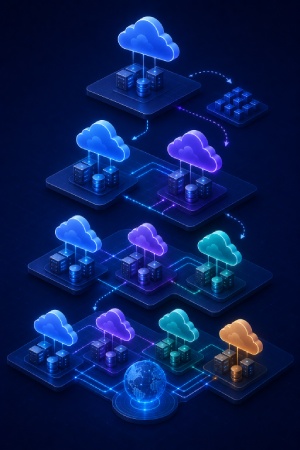
You see, multi-cloud almost never starts as a planned architecture. In real companies, especially ones that have been around for a few years, things usually evolve in a much less structured way than any diagram would suggest. It tends to come from small, practical decisions made over time, not from one huge choice.
Since selecting a cloud provider is the fastest method to get something up and running, it frequently begins with just one team. Usually, there isn’t a long analysis or major architectural discussion behind it. It’s a more logical choice that is typically made in an instant. Like those situations, when you see that something works, so you just use it.
Things are still very simple at that moment. Everyone uses the same basic set of tools, the system works in a single environment, and deployments follow a standard procedure. At that time, considering multiple providers or long-term infrastructure planning just isn’t possible because everything looks so manageable and simple to keep track of.
And How Do Things Start to Spread?
As time goes on, things just start to shift. Another team joins the company, or an existing product line starts moving in a new direction. That team might already be used to a different cloud provider, or they might find that certain services they need are easier to work with elsewhere. So they pick a different platform that fits them way better.
There’s no obvious moment where things switch or take a new direction. It just keeps growing over time, with each piece evolving in its own way depending on the team behind it.
Later, another use case shows up, and it can look different depending on the situation, for example:
- data processing jobs that just run more smoothly with certain tools on a different provider
- machine learning work that needs specific infrastructure or managed services another platform handles better
- services moved into a new region because a different cloud simply performs better there
- small performance or cost improvements that make using a second provider the more practical choice
And just like before, another cloud gets introduced into the mix because it solves a specific problem.
After a while, these small decisions start to pile up. It begins as a simple setup, but slowly ends up spread across different providers, even though nobody really planned it that way. You shouldn’t think of it as a clear moment where someone says, “okay, we’re a multi-cloud company now.” It just slowly becomes a reality as the system grows and changes.
That’s the part that people often overlook. Multi-cloud setups usually take shape over time through everyday needs, different practical choices, and the way different teams build and evolve the system.
Why Don’t Companies Stay on One Cloud Provider?
Sticking to one cloud provider seems like the simpler option, on paper. It’s easier to picture, easier to manage, and feels more controlled overall. In an ideal world, it would probably be the obvious choice. But in real systems, once things start growing and changing, that simplicity isn’t really there anymore.
Choosing the Right Tool
Every cloud platform is a little bit different. Even though they offer similar categories of services, the quality and ecosystem around those services can vary.
Different cloud platforms tend to develop their own strengths over time, so certain services naturally end up performing better in specific areas. Because of that, teams usually go with whatever fits their current problem most easily.
It’s usually not something that gets framed in a formal or structured way. People simply focus on what helps them build what they need at that moment, without getting too caught up in how it will all connect later.
Things usually get more complex because of lots of small changes. And it’s tricky, because each step feels reasonable on its own, even if it slowly adds more spread to the system. And yes, without even anyone really noticing.
As Teams Grow, The System Naturally Starts to Be Different
As companies get bigger, they stop working like one small, tightly connected group. New teams appear, responsibilities get split up, and people start focusing more on their own area than the whole system.
And then, keeping everything in place starts to get harder in everyday work. It’s not that they’re ignoring rules, but usually teams want to solve their own problems first (needless to say, often because of time pressure). And of course, those problems are not the same across the company.
| Team type | What they usually care about |
|---|---|
| Product/app teams | Shipping features quickly and keeping things responsive |
| Data teams | Handling large amounts of data efficiently |
| Internal tools | Stability and simplicity over everything else |
Migration is Expensive and Rarely Urgent Enough
In theory, a company could unify everything later, but in practice, that’s not the case. If they want to move a working system from one cloud provider to another, then they have to rewrite configurations, test infrastructure and update many many security rules. Just listing these tasks is a lot of work, let alone actually doing them. Most companies don’t do this unless they really have to, and if the system is working, the risk of migration often doesn’t matter as much as the benefit. So they keep building already existing things.
What Do Multi-Cloud Environments Actually Look Like?

From the outside, it just looks like one product. You open it, use it, and everything reacts in a way that feels connected and immediate. But inside, not one system does everything, but several things work together.
Login and the main application logic usually live in one part of the system, while data storage and backups are handled completely somewhere else. Analytics and processing usually run separately, and often don’t work directly with live user traffic in real time. On top of that, there are smaller services in the background that take care of things like logging what happens in the system.
There Is No Single Control Center
One of the most important things with multi-cloud systems is that there is usually no main dashboard where everything is managed. So when engineers work on the system, they’re constantly moving between different systems.
It often looks something like this in a normal workflow:
- Checking logs in one platform
- Changing settings or infrastructure in another
- Monitoring performance in a separate tool
- Jumping back and forth just to understand one issue
And then after a while it feels more like a set of connected parts that you navigate between. Well, depending on what you’re trying to fix or understand.
At the End, Integration Becomes the Real Architecture
In multi-cloud systems, the most important design work is not the platform itself, but how everything connects. For example things like APIs, network setups, data flows, and identity systems quietly hold everything together. They decide how information moves, how services talk to each other, and how users can access different parts of the system without even noticing the separation.
So basically, in many cases, the “architecture” is not one cloud system, but the connections between several cloud systems.
Things That Companies Actually Gain from Multi-Cloud Setups

Even with all the extra complexity, companies stick with multi-cloud because it solves a few very real, practical problems that would be harder to handle in a single setup.
Here’s what usually matters in real life:
- Systems are less dependent on one place: If everything is running through a single provider, any big outage can take the whole product down with it, and nobody wants that. Spreading things out helps avoid that kind of (very) annoying situation. It’s not always full backup systems everywhere, but more like keeping the most important parts from relying on just one point.
- Teams are more free to select what works: Certain services are just more suited for particular jobs than others. Instead of transferring every task on the same platform, businesses may use the tools that already fit their needs and process.
- Better reaction times based on location: Because users of the system come from all over the world, speed and response times vary depending on where you are. Without having to start from scratch, it is possible to make things feel faster and more stable by running elements of the system closer to where people actually use it.
Problems That Multi-Cloud Setups Start Creating

Unfortunately, the problems with multi-cloud systems don’t usually show up right away, and you only really notice them when the system starts getting bigger and more complex over time.
The Bigger the System Gets, The More Work It Takes to Run It
Each cloud provider works a bit differently, with its own tools and way of handling things. At the beginning, this feels like just a small thing. But as the system grows, it starts showing up at work. Engineers may end up dealing with more than one setup, and moving between them just becomes part of the routine. It doesn’t always slow things down, but it does make everything feel more stressful over time.
Keeping Security Consistent Becomes More Difficult
Security rules are supposed to work everywhere, but “everywhere” now often means different platforms with different setups and ways of configuring things. It’s not that simple to make sure access, user permissions, and network rules all stay aligned across these systems. It’s easy for small differences to slip in, especially when different teams are handling different parts of the setup.
Costs Become Harder to Track
Costs are split across different providers, so there’s no single place where everything shows up. Each platform calculates and reports spending in its own way, so the numbers don’t always match directly. To understand the total spend, everything has to be gathered from multiple places, which takes a lot of extra effort.
What An Engineer’s Day Looks Like In Multi-Cloud Setups
From an engineering point of view, multi-cloud setups often focus more on keeping track of where different parts of the system are running and how everything connects.
Finding Problems Takes Longer in Multi-Cloud Systems
When something is not good, the first step is often just figuring out where it actually went wrong. Logs might be stored in one cloud, metrics in another, and traces in a completely different tool. Nothing is in a single place, so the information has to be pieced together, and yes, one by one. Putting together what happened in one user request across all these systems can take quite some time, especially when each part of the setup is slightly different.
The Same Deployment Can Behave Differently
Even if the same application is deployed across different clouds, it doesn’t always act exactly the same. There can be small differences in networking, configuration, or underlying infrastructure that can change how things behave. Most of the time these changes are very minor, but they can still lead to issues.
Moving Data Between Clouds Can Be Hard
Moving data between cloud providers can take more time and money than many people expect, especially when large amounts of data are involved. Because of this, companies often plan carefully where data is stored and how often it needs to move between systems.
But How Do Companies Keep Multi-Cloud Systems Under Control?
Most companies knows very well that with multi-cloud, complexity is definitely there. The goal usually is to stop it from becoming a daily problem, and not just to remove it completely. To manage it, applications are kept portable with tools like containers, so they’re not tied to one platform. And when something breaks, teams use shared logs and alerts instead of checking many separate systems.
Bringing Multi-Cloud Complexity Under Control
In many companies, multi-cloud ends up being the result of adding new systems, services, and tools whenever they are needed. After that, the focus is on keeping all these parts working together in a reliable way, since more pieces also mean more things that can go wrong. Over time, they’re able to control a very complicated system.