
Using multiple cloud providers as an organization or business enterprise offers a wide range of benefits. It’s even usually done to support the growing needs of the organization and enhance operations. However, it does come at a cost.
In fact, oftentimes, organizations, in a bid to support growth and improve operations, keep adding new and, honestly, necessary cloud services to their technology stack. And before they realize it, what started as a strategy to improve operations can turn into a major spending challenge. This, therefore, creates an important question: How do enterprises control the spending associated with multi-cloud infrastructure while still enjoying the benefits it provides?
We will answer that question in this article. We will explore the major factors that drive multi-cloud infrastructure costs and examine the techniques enterprises use to keep spending under control while maintaining efficient, reliable, and scalable cloud operations. Let’s dive right in!
Inside the Multi-Cloud Model: Flexibility, Resilience, and Complexity
Let’s start by first understanding what a multi-cloud infrastructure is and why so many organizations use it in the first place.
Simply put, a multi-cloud environment is an IT infrastructure where an organization uses services from two or more cloud providers at the same time. For example, an enterprise may use one cloud provider for data storage, another for data analytics, and a third for application hosting. Each provider may offer unique capabilities, pricing structures, or performance advantages that make it suitable for specific business needs.
Why Enterprises Adopt Multi-Cloud Strategies
There are several reasons why an enterprise may choose to adopt multiple cloud providers. Some of the most common include:
- Accessing Specialized Cloud Services: Different cloud providers have different strengths. Organizations use multiple providers to take advantage of the best services for each platform provider.
- Improving Resilience and Redundancy: Milt multiple cloud providers, If one provider experiences an outage, an enterprise can continue running on another platform.
- Avoiding Vendor Lock-In: Relying on a single cloud provider can make switching later platforms difficult and expensive. Using multiple providers gives organizations greater flexibility and independence.
- Meeting Regulatory and Geographic Requirements: Using certain cloud infrastructures enables some organizations to stay within specific regulations that govern data storage and processing in specific regions.
Why Multi-Cloud Costs Can Become Difficult to Control
As you can see, using multiple cloud providers offers many benefits. However, it can also make cost management significantly more complicated. Some of the main reasons for this include:
- Multiple Billing Systems: Each cloud provider has its own pricing structure, invoices, usage metrics, and service categories, which makes it more difficult to track overall spending.
- Distributed Resources: When applications, databases, storage systems, and computing resources are spread across different cloud environments, it becomes harder to determine how resources are being used and whether they are being used efficiently.
- Underutilized or Unused Resources: Sometimes organizations continue paying for services, subscriptions, or infrastructure that are no longer needed simply because they are difficult to identify across multiple platforms.
- Increased Operational Complexity: Managing different tools, interfaces, and configurations across multiple cloud providers adds complexity to cloud operations.
- Limited Visibility: With resources spread across multiple environments, maintaining a complete view of cloud usage and costs becomes more difficult. And this allows inefficiencies and unnecessary expenses to go unnoticed.
Major Cost Drivers in Multi-Cloud Environments
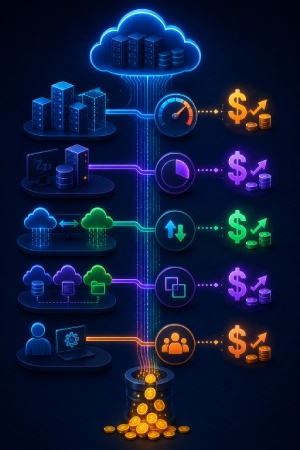
Of course multi-cloud spending is difficult to control, but what actually drives those costs. While cloud spending may seem to rise gradually over time, there are usually specific factors behind the increase. They include:
Overprovisioned Resources
This occurs when organizations allocate more computing power, memory, or storage than their workloads actually require. While this is often done to prevent performance issues, it can result in paying for capacity that is rarely or never fully utilized.
Idle and Underutilized Infrastructure
Organizations often continue paying for resources that are no longer needed or actively used. These may include unused virtual machines, inactive databases, or forgotten development environments that continue generating charges despite providing little value.
Data Transfer and Network Traffic Costs
Moving data between cloud providers, regions, applications, and users can generate high costs. And for enterprises handling large volumes of data, these network traffic expenses can become a major part of overall cloud spending.
Duplicate Services Across Cloud Providers
As organizations adopt multiple cloud platforms, they may end up running similar monitoring tools, storage solutions, backup systems, or security services across different environments. And since they have a large system, they might not be aware. These overlapping services can create unnecessary costs over time.
Operational and Management Overhead
Managing multiple cloud environments requires additional administrative effort. This can increase staffing, support, training, and management costs.
Cloud Cost Management Strategies Used by Enterprises

Now that we understand some of the major factors that drive cloud spending, the next question becomes: how do enterprises keep these costs under control?
The reality is that organizations do not simply wait until cloud costs become a problem before taking action. Instead, many adopt structured cost management strategies that help them monitor spending, improve efficiency, and prevent unnecessary expenses from accumulating. These strategies provide greater visibility into cloud usage and help ensure that resources are being used in the most cost-effective way possible.
Here are the strategies below:
Establishing Cloud Cost Visibility
The first step in controlling cloud spending is understanding exactly where the money is going. After all, it is difficult to manage costs that cannot be clearly seen. To achieve this, many enterprises use centralized cost dashboards and unified reporting systems that bring spending data from multiple cloud providers into a single view. So rather than reviewing separate invoices and usage reports from each platform, decision-makers can monitor overall cloud spending from one location.
Many organizations also rely on real-time spending monitoring. This allows them to track costs as they occur rather than waiting until the end of the month when the bill arrives. And so with greater visibility into resource usage and spending patterns, enterprises can identify inefficiencies much earlier and take corrective action before costs escalate.
Implementing Cloud Financial Management (FinOps)
Visibility alone is not enough. Organizations also need a structured approach for managing cloud costs, which is where FinOps comes in.
FinOps, short for Financial Operations, is a framework that helps organizations manage cloud spending through collaboration between finance, operations, and engineering teams. Rather than treating cloud costs as solely a finance issue or an IT issue, FinOps encourages all relevant teams to work together to make informed spending decisions.
Under a FinOps approach, engineering teams gain greater awareness of the financial impact of their infrastructure decisions, while finance teams gain better visibility into how cloud resources are being used. This creates a culture of continuous cost accountability where spending is regularly reviewed, measured, and optimized.
Budgeting and Cost Governance
Many enterprises assign cloud budgets to specific departments, projects, or business units. This helps ensure that teams understand how much they are expected to spend and encourages more responsible resource usage.
Organizations may also implement spending policies that define how cloud resources should be deployed and managed. For example, certain resource requests may require approval before they can be provisioned, particularly if they involve high costs.
Using Cost Monitoring and Alert Systems
Automated monitoring and alert systems continuously track cloud spending and notify teams when certain conditions are met. For example, alerts may be triggered when spending exceeds predefined thresholds, when resource usage suddenly spikes, or when unusual cost patterns are detected.
Resource Allocation and Infrastructure Efficiency
Gaining visibility into cloud spending is an important first step. However, visibility alone does not reduce costs. Once organizations have a clear understanding of where their money is going, the next step is ensuring that cloud resources are being used as efficiently as possible. Here’s how to ensure that:
Rightsizing Cloud Resources
Rightsizing involves matching cloud resources to the actual demands of the workloads they support. Many organizations usually provision more computing power, memory, or storage than they truly need. While this may provide a safety margin, it also means paying for capacity that is rarely used.
To address this, enterprises must continuously evaluate workload performance and resource utilization. This will help them identify resources that are larger than required and adjust them accordingly.
Automating Resource Scaling
There are some applications that sometimes get used a lot, and at other times, not so much. Instead of permanently allocating resources at the scale needed when they are at peak usage, many organizations use auto-scaling mechanisms. These systems automatically increase resources when demand rises and reduce them when demand falls. This helps maintain performance during busy periods without paying for excess capacity during quieter times.
Eliminating Idle Resources
Over time, organizations may accumulate unused virtual machines, inactive databases, and other assets that continue generating charges despite providing little or no value. In large multi-cloud environments, these resources can easily go unnoticed. To address this issue, regular audits of cloud infrastructure are needed to identify unused assets and discontinue them, thereby saving money.
Improving Storage Efficiency
Storage is another area where cloud costs can quietly grow if not properly managed. Many organizations store large volumes of data, but not all of this data needs the same level of accessibility or performance. And so, organizations also reduce storage costs by archiving data that must be retained but is rarely accessed. In addition, they can also remove duplicate, outdated, or unnecessary data.
Traffic Optimization in Multi-Cloud Environments
As mentioned earlier, network traffic costs can also become a significant expense in multi-cloud environments. This is why traffic optimization is also an important part of multi-cloud cost management. Below are key strategies for traffic optimization:
- Understanding Network Traffic Costs: To understand traffic optimization, it is important to first understand how network traffic generates costs. Cloud providers often charge organizations for moving data between environments. Internal traffic may be free or relatively inexpensive, but charges do increase when data moves outside a cloud provider’s network, between regions, or across different cloud platforms.
- Reducing Cross-Cloud Data Transfers: To reduce costs, enterprises can keep closely related workloads within the same cloud environment whenever possible. For example, an application and the database it relies on may be hosted on the same cloud platform rather than being separated across multiple providers.
- Optimizing Data Routing: Organizations can use intelligent traffic management solutions that automatically determine the most efficient routes for data transmission. This will not only help reduce transfer costs but also improve application responsiveness and overall user experience.
- Leveraging Content Delivery and Edge Services: Content delivery services work by storing copies of frequently accessed content closer to end users. Instead of repeatedly retrieving the same data from a central cloud environment, users can access nearby copies, which reduces the amount of traffic flowing through core infrastructure.
Workload Balancing Across Multiple Cloud Platforms

While traffic optimization focuses on how data moves across cloud environments, workload balancing focuses on where applications, services, and workloads are placed in the first place.
In a multi-cloud environment, not every workload needs to run on the same cloud platform. Different applications have different requirements, and some cloud providers may be better suited to certain workloads than others.
Workload balancing involves strategically distributing workloads across multiple cloud environments based on factors such as cost, performance, reliability, and resource requirements. The goal is to ensure that workloads are running where they can operate most efficiently while delivering the performance and availability the business requires.
Placing Workloads Based on Cost Efficiency
Cloud providers do not charge the same prices for computing, storage, networking, and other services. As a result, a workload that is expensive to operate on one platform may be significantly cheaper on another.
To take advantage of these differences, enterprises regularly compare pricing across cloud providers and place workloads where they can be operated most cost-effectively. This allows organizations to reduce infrastructure expenses without necessarily reducing the quality of service being delivered.
Matching Workloads to Cloud Strengths
Some platforms may offer highly efficient solutions for compute-intensive workloads that require significant processing power. Others may provide more cost-effective storage options for organizations managing large volumes of data. By matching workloads to the strengths of each cloud provider, organizations can improve both operational efficiency and cost effectiveness.
Dynamic Workload Distribution
Workload balancing is not always a one-time decision. Business requirements, resource demands, and cloud costs can change over time. For this reason, many enterprises adopt dynamic workload distribution strategies. These approaches allow workloads to be shifted between cloud environments when conditions change.
Operational Practices That Reduce Multi-Cloud Costs
Long-term cost control also depends on how cloud environments are managed on a day-to-day basis. Even the best cost management tools can only do so much if organizations lack clear processes, consistent oversight, and accountability. This is why many enterprises adopt operational practices that help improve efficiency, reduce waste, and ensure cloud resources are used responsibly. Some of these practices include:
Standardizing Infrastructure Management
Without standardization, different teams may follow different procedures, use different configurations, and implement inconsistent policies. This can create inefficiencies, increase management complexity, and make cost control more difficult.
To address this, organizations often establish consistent policies and unified operational procedures across all cloud environments. This creates a more organized infrastructure, simplifies management, and helps ensure resources are deployed and maintained in a consistent manner.
Automation and Infrastructure as Code
Many organizations use Infrastructure as Code (IaC) to automate the deployment and management of cloud resources. That is, instead of manually configuring infrastructure, predefined templates and scripts are used to automatically create and manage resources whenever they are needed.
This approach reduces the risk of configuration errors that can lead to wasted resources or unnecessary spending. It also speeds up deployments, improves consistency, and reduces the amount of manual effort required from IT teams.
Continuous Monitoring and Optimization
Controlling cloud costs is not a one-time activity. As business needs evolve and workloads change, cloud environments must be reviewed regularly to ensure resources are still being used efficiently.
For this reason, many enterprises conduct ongoing performance reviews and cost-performance analyses. These evaluations help determine whether resources are delivering sufficient value relative to their cost. Organizations also perform regular infrastructure audits to identify underutilized resources, outdated services, and opportunities for optimization.
Strengthening Team Accountability
By making cost management a shared responsibility rather than the sole responsibility of finance or IT leadership, organizations can build habits that support long-term cloud efficiency. For example, when engineers, developers, and operational teams understand the financial impact of their decisions, they are more likely to use resources efficiently.
Keeping Multi-Cloud Costs Under Control
Enterprises adopt multi-cloud infrastructures because of the numerous benefits they offer. However, these benefits also come with costs. And as they add more cloud providers, services, and workloads to their infrastructure, cloud spending can quickly increase. And since these infrastructures often play a critical role in keeping business operations running, simply reducing cloud usage is usually not an option.
Instead, enterprises must find ways to control and optimize their spending. This is why organizations invest in cost visibility, resource optimization, traffic management, workload balancing, automation, and strong operational practices. These strategies help ensure that cloud resources are being used efficiently while unnecessary expenses are kept to a minimum.