
Cloud-based apps
have become an integral part of today’s businesses for their everyday activities, customer engagements, and internal communication. With the move towards a distributed infrastructure and a growing number of deployment scenarios in hybrid environments, there has been an increased focus on application performance. Any app users will expect faster loading duration, continuous connectivity with no disruptions and responsive digital experience as well. Small lapses can make a big difference in customer satisfaction, productivity, and operational efficiency.There are variations in cloud services; some are flexible, highly scalable, while at the same time representing a challenge in terms of complexity. The app might run over a wide geographic area, use several related services and be accessed by thousands of users at any given time. For this reason, organisations have to constantly track and fine-tune performance to ensure reliability and responsiveness. When requirements for improvement are not merely expanded server size, then the specific improvements can be more targeted. Today it includes latency improvement, observability, traffic optimisation, edge networking and well-thought infrastructure planning.
Understanding Application Performance in Cloud Environments
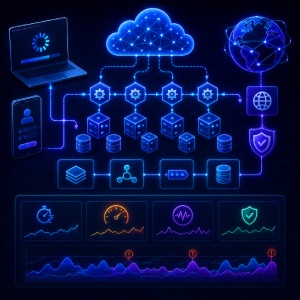
The performance of an application is the ability to respond to one or more user requests and process a workload. Performance in a cloud environment will need to consider a mix of design/architecture infrastructure, network quality, application architecture, and data processing efficiency.
Old fashioned systems run in reasonably restricted environments. Cloud systems, however, are spread across a number of servers, regions and services. While this helps to scale well, there is more that can impact response time as well.
Cloud Applications typically consist of numerous microservices and not one system. Both services use a REST based API to communicate with each other and make a network call. A disadvantage of this structure is the potential for service synchronisation issues, but it makes it very flexible.
Some performance problems in cloud systems can encompass low loading speeds for pages, latency in API responses, irregular uptime, or network jams. These issues are for both the customer and internal use purposes, and using performance optimization is an evergreen element of day-to-day operations.
Why is Reducing Latency so Important?

Latency is the time between an active user’s response and the system’s response. Web latency can be due to many factors like network distance, overloaded infrastructure, inefficient code and delayed database queries.
Decreasing latency is essential, because users want instantaneous responses from digital services. Studies always establish how vital up-to-the-minute is to engagement and reducing dropouts.
One way businesses work on reducing latency is by improving their architecture and infrastructure placement. A popular approach is to deliver applications near the user by utilizing regional cloud or edge infrastructure.
Another popular method is caching. These are called local caches, and any content that is accessed more often is stored locally near the user instead of making repeated requests to the central databases. This is a considerable improvement of retrieval speed.
Load balancing is also very important. Each server gets the traffic to be processed so that one does not get overloaded. Organisations can manage to distribute the workloads efficiently and in this case stitch up the response speeds during the peak usages.
Traffic Optimisation Strategies
With traffic optimisation, attention is on how data flows between users, servers, and applications. Network traffic grows in complexity and usage as enterprises scale their application operations to the cloud.When they expand their application operations into the cloud, network traffic gets more use and complex.
Instability in the application domain is mitigated with efficient traffic management. This includes managing the sudden surges of traffic, the availability of the network at peak load times as well as preventing network congestion.
These are the types of optimisation approaches that are generally used by companies:
- Content delivery systems route content like images, scripts and videos to geographically spread servers to minimize delivery times.
- Compression formats make a file smaller prior to transmission, which means that loading time and bandwidth requirements decrease.
- Intelligent routing systems are designed to choose the fastest and most reliable routes for data to flow across networks.
- Incoming traffic is split among a number of servers to increase reliability and prevent bottlenecks (load balancing).
- Infrastructure resources automatically scale up and down as per the current traffic needs in an autoscaling system.
These methods allow enterprises to keep up with variable user activity even.
The Role of Application Observability
The observability of applications has been deployed during cloud operations as a big agenda item. Observability is the capability to comprehend the inner state of an app through analysis of the metrics, logs, traces, and system behavior.
The ability to simply determine if systems were operating was a traditional monitoring characteristic that was largely ignored. This is where observability extends to understanding why issues arise, and how various parts of the distributed system relate to each other.
A lot of operational information is generated in modern usages. These data are gathered and analysed by observability platforms, providing real-time insight into any anomalies, investigations into incidents, and better system performance for teams.
Metrics are quantitative measurements like CPU utilization, memory usage or response time. Logs are used to capture events in applications, and distributed tracing is used to track requests that are passed between services.
These tools can be used in combination to create a comprehensive picture of the behaviour of an application. The reason why this visibility is particularly crucial are in microservices land, where problems can arise from many interconnected systems.
Why Observability Improves User Experience
The direct benefits of observability are improved user experience, and improved detection and resolution of problems, which leads to faster detection time. If the issues affecting the system are not visible, they could go unnoticed until users are allowed to report the problems.
Real-time analysis helps teams operating their service realize that particular parts of their service are slow, APIs are failing, or infrastructure is overloaded before they impact large volumes of users. This forward-thinking strategy minimises downtime and boosts reliability.
Long term optimization is another facet of observability. Through monitoring trends in usage and system performance, enterprises can gain insights into recurring slowdowns and optimize their systems.
Here are a handful of observability practices which help organisations improve their performance:
- Real-time monitoring dashboards enable teams to keep abreast of the health of an application across distributed environments on an ongoing basis.
- Distributed tracing is used for tracing delays encountered between various interconnected microservices and APIs.
- Automated alerts alert the team as soon as performance thresholds are breached.
- The use and analysis of historical performance, aides long term infrastructure planning and optimisation decisions.
- Log aggregation tools monitor and aggregate operational data so that it can be quicker to troubleshoot and react to incidences as a single.
Edge Networking and Distributed Infrastructure

As enterprises try to support users and connected devices all over the globe, Edge networking has become more important. Edge Computing brings some of the operations closer to the end users, instead of going all the way to Central Cloud Regions.
By doing so this method helps to eliminate latency, which is the time delay needed for data to get from point A to point B. The edge infrastructure could consist of multiple regional servers, caching nodes, or local processing centres located closer to the users.
Traditional applications that call for demanding real-time responsiveness like video streaming, online gaming, financial services, and industrial applications can greatly benefit from edge networking. In such instances, any lag or slowdown can make a huge difference in usability.
Today, cloud service providers are providing edge services to enable organizations to spread their work over different places. On top of all that, these services are available to support enterprises to enhance their performance without owning a global infrastructure.
Resilience is another capability of edge networking. If any node or region is congested, the traffic can be rerouted to other nodes in the proximity if feasible, thereby not affecting the users too much.
Microservices and Performance Optimisation
Microservices architecture is applied by many enterprises for better scaling and development for flexibility. In this pattern, applications are broken into separate, independent services that interact and communicate via APIs.
The microservices enable the ability to scale or to remove or add sub-components without having to impact the overall system. These can also make operations more complicated, however, because various services need to be able to operate synchronously.
When building an application with microservices, there’s a need for cautious coordination for performance optimization. Services vary in how quickly they can communicate with each other, so adding an extra layer of latency to addresses that are distributed across regions.
To solve these, organisations leverage service meshes, minimize extra requests and optimize the server-to-service communication. Platforms for container orchestration facilitate deployments and scaling, too.
In microservices environments, it is particularly important that everything can be observed correctly, since problems with performance can arise in a single service, but result in problems across the entire application.
The Impact of Cloud Scalability
An important benefit of cloud computing is its scalability. Infrastructure resources can be expanded dynamically when required by the enterprise and not to meet fixed standards.
However, just because something is said to be scalable does not mean it will perform. Wrongly configured scaling systems could result in destabilisation or in an unneeded cost.
Auto scaling technologies enable applications to scale resources automatically based on varying workloads. If demand increases the servers or containers are deployed to maintain the responsiveness of the system. If the need for resources is reduced the resources are brought down to improve efficiency.
By offering flexibility, this enables companies to supply uniform user experiences whilst managing costs.
Creating Balance Between Security and Performance

Security needs should also be considered for cloud performance optimization. Enforcement of encryption, authentication and traffic monitoring consumes resources and may cause extra-processing time.
Balancing security controls and response. Optimised encryption protocols and distributed security services are used in modern systems to reduce the impact for the system.
Many cloud-based architectures now have web application firewalls, secure API gateways, and identity management systems built-in. These tools shield apps from threat and ensure smooth traffic movement.
The increasing value of security observability is another factor. More and more, the enterprises that integrate the performance monitoring and security analytics together, collecting data to spot any threats or operational abnormalities at once.
The Role of Artificial Intelligence in Performance Optimisation
Cloud performance management is increasingly taking advantage of AI and machine learning tools. AI systems can process a huge amount of operational data much faster than humans.
These systems are used to detect irregular behavior, warnings of failures, and automated optimization. For instance, AI technologies could flag very high latency spikes or suggest changes in infrastructure before issues emerge.
Predictive analytics also provides the support of capacity planning. Historical trends can be analysed to forecast demand and optimize resource allocation, which is beneficial for organisations.Organisations can benefit from analysing historical trends to anticipate demand and allocate resources more appropriately.
Another benefit of automation is its ability to boost operational efficiency. Normal day-to-day problems like scaling parameters, re-routing traffic and anomaly detection can be performed increasingly without human interaction.
Problems in Distributed Cloud Environments
In spite of optimisation technology developments, distributed cloud technologies are still challenging. Businesses need to operate several providers, regions, devices and service-woven together.
The reliability of the network is different in various areas and it may be impossible to process or store data according to the regulatory requirements in place. These factors need to shape infrastructure decisions and optimisation strategies.
Another obstacle posed by legacy systems is the potential for integration problems. Many organisations keep using old applications with new applications based on Cloud. It is important they are compatible in order to be capable of these.
Things get even more complicated when businesses turn to hybrid and multi-cloud solutions. A single strategy for observing and performance needs to be implemented across platforms.
The Future of Cloud Application Performance
As user behaviors, infrastructure designs, and enterprise technology adoption change, cloud application optimization will evolve. Distributed systems are getting more sophisticated and so are their expectations of speed and reliability.
Edge computing, AI optimisation, and automated observability tools are expected to become more intricately woven into enterprise applications. Organisations will be able to tackle performance issues in a more effective manner in increasingly complex environments with the help of these technologies.
Similarly, users’ expectations will continue to influence optimisation priorities. The demands businesses face are increasing, demanding more cohesive digital experiences, no matter the location, device or network involved.
Collaborating with other departments to incorporate them into sustainable infrastructure planning.Simultaneously, issues of sustainability can inform infrastructure planning. Businesses are starting to consider not only the energy saving and resource use, but also the performance optimisation.
Building Faster Cloud Experiences for the Future
Optimising application performance is now an essential element of enterprise cloud strategy. In today’s business world, having responsive, reliable systems is essential for business, customer service, and keeping competitive in the digital world.
By leveraging latency reduction, traffic optimisation, observability, edge networking, and infrastructure management, enterprises can boost the performance of distributed applications, all while ensuring scalability and growth.
It will continue to be vital that the performance can be monitored, analysed and optimized as cloud systems grow in complexity. A focus on visibility, responsiveness and designing infrastructure to perform efficiently will help enterprises succeed in delivering seamless user experiences in increasingly fragmented digital ecosystems.