
When businesses are growing and making the transition to digital, aging systems could be challenging to maintain. Legacy applications can be using outdated software infrastructures, lack integration options, and have fixed deployment methods. They can slow down development procedures; drive up operational expenses; and make it difficult for organisations to react to market needs. As a result, numerous organisations are focusing a large portion of their investments on their enterprise application modernisation strategies.
Even if a modernisation could take place, it does not necessarily have to involve a complete replacement of systems. Frequently, organisations evolve applications over a period of time without affecting critical functions. This encompasses moving to the cloud, API integration, workload transformation, infrastructure redesign and organizational restructuring. The aim is to enhance scalability, agility, long-term resilience and maintainability without impacting critical services.
Understanding Legacy Applications
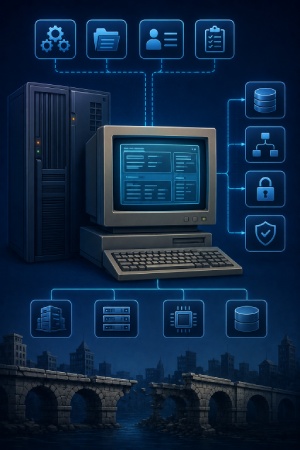
Legacy applications are applications or legacy processes that are still used for critical business processes within the organisation. Some were created to support on-premises infrastructure, and others were built prior to the ubiquitous adoption of cloud computing.
These applications may be very business-critical. These can contain years of operational logic, customer data, compliance procedures, and bespoke procedures. It can be costly to replace them altogether, and potentially dangerous as well.
The problem with many legacy systems was that they were monolithic systems in which everything was held within a single program. Modifications to this structure can be complicated since modifying one function could impact the whole application.
Older programming languages, tightly coupled databases, and hardware dependent environments are also common in legacy environments. In due course, upkeep of these systems gets more complex, more difficult to manage technically, more dated, or more complex as other infrastructure ages.
Although these hurdles can be an issue, legacy systems have their own necessity since they continue to serve vital operations of the business that could be relied upon to remain functional.
Why Are Businesses Modernizing Applications?
With the move to cloud computing, people have come to expect certain performance and operational requirements. The systems that businesses have now are expected to scale rapidly, equally support remote access and integrate with cutting edge tools, while also managing changing workloads efficiently.
Many legacy applications cannot keep up with the expectations. They might need manual deployments, a limitation on their scale, or might not support cloud-native services.
The cost of operation plays a role in modernisation decisions. Over time maintenance of ageing equipment and equipment vendors, outdated software licensing and specialised infrastructure might become more and more costly.
Security issues are also a significant consideration. Vulnerability could be higher with older applications that don’t get updates or support newer security frameworks.
Here are a number of reasons why companies upgrade their applications:
- Cloud-ready systems do more to help maximise scalability and enable organisations to handle changing workloads more efficiently.
- Automated pipelines minimize dev and ops overhead and accelerate software delivery.
- New security policies enhance the security measures taken to face current threats.
- Improved maintainability means lower life-time infrastructure/service costs.
Application Migration Strategies
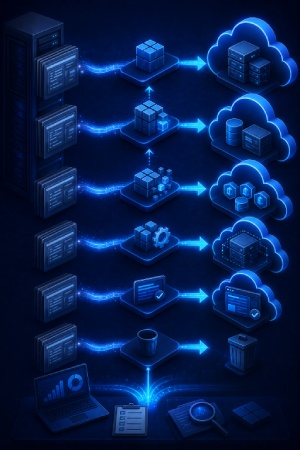
The journey towards application modernisation typically starts with application migration. Few companies undertake such an entire change as they do not want to include any risks when they change systems. Organisations, instead, assess the workloads individually and choose migration strategies based on technical requirements, business requirements, and budget.
The “6 Rs of cloud migration” certainly rose to fame as one of the most talked about models for migration. These can guide organisations on the management of each application for modernisation.
One of the rehousing options is sometimes referred to as “lift and shift” and includes moving applications into cloud environments with minimal modifications. It enables an organization to transition rapidly, but doesn’t necessarily take full advantage of cloud-native features.
Refactoring is a process of redesigning some of the application components to enhance application scalability, flexibility and compatibility with cloud infrastructure. Such a methodology can be more time consuming, but offer greater advantages in time.
Between these two models is re-platforming. A subset of applications are mixed and matched to make them more cloud-friendly without much of the existing application architectures being changed.
In some cases, systems are completely retired and replaced with newer software platforms while in other cases, they are removed from operation when they no longer offer operational value.
Migration can happen in various ways, depending on the complexity of the application, operational risk and organisational objectives.
API-Driven Architectures and Integration
Application programming interfaces (APIs) have become a key element of the modernisation process. APIs enable various systems and services to securely and efficiently communicate with each other.
Legacy applications sometimes were created as “batch” systems that don’t use the integration capabilities available within those applications. Today companies demand more of an environment, where applications can share data with other applications, real-time, through integration services, cloud services, mobile platforms, analytics etc., etc.
API-driven architectures facilitate progressive modernization and not a complete overhaul. Current applications can continue running with the option of exposing specific functions via APIs.
In this way, an organisation can maintain its important business logic whilst enhancing interoperability. It also facilitates the digital transformation effort, allowing the consolidation of data between departments and services.
API management platforms offer authentication, monitoring, traffic control, and security enforcement features. These solutions assist organisations to control the increase in integrations.
The expansion of cloud usage within enterprises is increasing the proclivity to use APIs as the cornerstone of scalable, modular infrastructure design.As enterprises grow more into the cloud, API use is growing and more so than ever before as a foundation for scalable, modular infrastructure designs.
Microservices and Workload Transformation
A large number of projects in the process of modernisation consist of replacing single application with microservices architecture. With microservices, an application is segmented into discrete, independent services.
Different services serve specific purposes with each having their own API to interact with each other. This architecture also enhances scalability, allowing various services to scale their resources as needed, without affecting other parts of the system.
There’s also a gain in agility for the development cycle with microservices. Services can be updated or deployed without impacting the application.
But workload transformation is generally a gradual process as opposed to a substitute implementation. But perhaps a more appropriate strategy is to start by breaking apart smaller inner services within bigger ones, and then gradually migrate the use of microservices up the chain.
These are a number of transformation practices that are common for cloud modernisation:
- Containerisation encapsulates applications within movable environments, which run in a consistent manner through infrastructure platforms.
- The microservices architecture separates applications into more discrete, independent services to scale and be more flexible.
- API gateways control the flow of communication between services and enhance security and traffic management.
- Service orchestration platforms can be used to automate deployment, scaling, and management of workloads.
Containers, Kubernetes and the Game
Containerisation is one of the crucial components of application modernisation today. Applications and their dependencies are packaged in Containers, giving them the ability to run in a uniform way across the various environments.
Containers are small and efficient, whereas traditional virtual machines are not lightweight, cannot be efficiently scaled, and require a lot of space. They enable quick deployment and ease of workload portability between cloud platforms.
With the rise in the usage of containerization, many orchestration platforms like Kubernetes featured prominently to coordinate the deployment of large container-focussed applications. Throughout a distributed system, recovery workloads, monitor and scale is automated by Kubernetes.
Containers and Kubernetes are often integrated into modernisation projects to achieve more flexibility of operations. Applications can be scaled up through continuous updates and dynamically scaled in collaboration with hybrid or multi-cloud infrastructure.
Organisations can deploy more frequently with lower risk to their operational environments, also using Continuous integration and delivery pipelines with Kubernetes.
In an increasingly digital and cloud-native world, these are now at the heart of many of the modernisation strategies.
Challenges Affecting Modernisation
It is rarely very easy to modernise legacy applications. Operational problems at many organisations are associated with system complexity, be it due to integration needs or changes in the organisation.
Legacy applications may feature processes and workflows that are not documented, or non-standard.Legacy applications tend to have many customised workflows or processes that have been devised over many years and are not well documented. These systems need to be analysed in detail for understanding, before migration can take place.
It is a challenge when downtime risks occur, as well. Systems need to be resilient to transformation projects and often cannot get transformed aggressively in critical applications.
When combined with skill gaps, modernisation can be difficult. Organizations and teams that have experience with traditional infrastructure might need the skill-set to master cloud-native technologies, automation, and distributed systems.
As migration unfolds, operational visibility is more and more critical. It’s important for organisations to have observability tools that give them visibility into how their applications behave in both the legacy and cloud worlds.
Modernisation projects can involve collaboration between a range of teams including development, infrastructure, security and business.
Security Tips to Apply When Adopting Cloud

As an application is modernising, security is always a primary concern. The adoption of distributed cloud computing services affects how organisations are monitoring access, data protection and infrastructure security.Organisations have had to adjust their monitoring approaches for access, data protection and infrastructure security when moving to distributed cloud environments.
Legacy applications can include legacy authentication mechanisms, legacy software components or other parts that are no longer supported, exposing significantly more risks to security. Usually, when a modernisation project is undertaken, there is an attempt to reinforce identity management and access control policies.
Cloud-native security strategies are generally centered on segmentation, encryption, auto-monitoring, and zero-trust access strategies.
The need for API security grows with it too. APIs play a key role in modernised applications, which are heavily dependent on the interoperability of services and APIs, and they need to be defended against unthrottled use and misuse.
Security automation aids organisations to stay compliant and ensure continuous exposure detection during development and deployment.
Modernising with consideration to security creates operational risk reduction and ensures long-term security.
Infrastructure Automation and DevOps Practices
The changes in operational infrastructure use that often result from cloud modernisation. Traditional environments were used to heavily rely on manual configuration and deployment processes. The trend is toward more automation.Automation is a growing characteristic of cloud-native systems.
Within the realm of infrastructure-as-code, the infrastructure team creates infrastructure configurations with code instead of doing them manually. This would help ensure consistency and moderate the possibility of having set up in the wrong way.
Modernisation too is a major part of DevOps practices. Development and operational teams work closely to promote quick deployment, test processes, and operational dependability.
Software testing and deploying are automated using a pipeline of continuous integration and continuous deployment. Organizations can send updates out faster and with less disruption to the operations.
Automation makes infrastructure more scalable and can react dynamically to workload changes without a lot of manual effort.
Modernisation Paths for Hybrid & Multi-Cloud
All organisations don’t necessarily transition to full public cloud. Many prefer multi-cloud or hybrid solutions between cloud and on-premises infrastructure.
Hybrid environments enable organisations to step by step transition to the modern world without compromising on specific workloads, or regulatory standards.
Multi-cloud solutions minimize vendor lock-in and enhance resilience and business agility.
With containerisation and orchestration, it becomes easier to move workloads between environments. Applications are always repeatable everywhere they’re deployed.
Distributed infrastructure also makes managing the system more complex, though. Organisations need to have a uniform policy of security, monitoring and governance across platforms.
For organisations running hybrid and multi-cloud environments, unified management and observability are crucial.
Human Impact and Organizational Impact

Application modernisation is not just a bit of code. It also has an impact on organisational culture, workflow and team structures.
In the past, the Dev, Ops and Sec teams were scattered across different departments within enterprise environments. Cloud-based systems promote more collaboration between these functions.
New technologies and deployment models, as well as operational practices may need training efforts. This shift can take a lot of organisational steam.
Support from leadership is also a key factor. A modernisation project can be multi-year and should not only involve a large capital outlay, but also ongoing investment.
When employees are not used to the new systems, or fear disruption of operations, resistance to change can result. Ensure that information is communicated clearly and that there are step-by-step implementation plans to reduce uncertainty.
Food system scale-ups usually play out a collaboration between technical and organisational readying.
Modern Applications Start with Smarter Infrastructure
The bottom line is, legacy application modernisation is increasingly becoming a key priority in enterprise cloud strategies. Systems are being redesigned in order to enhance technical and operational efficiency, flexibility, scalability, sustainability, etc., as well as any technical performance improvements.
With migration strategies, API-driven architectures, containerisation, microservices and infrastructure automation all playing a part of this transformation. These methods enable organisations to integrate legacy systems into current distributed networks without causing disruptions in critical operations.
Modernisation impacts not only on the way a team works, but also on the methods of security and infrastructure management when implementing applications. Organisations that adopt cloud systems and enhance their build, know-how and practices to address the changing requirements of the cloud era will be in a better position to meet the challenges.
Modernisation is successful when innovation and continuity are achieved. Enterprises need to maintain critical business operations while developing infrastructure for future development of digitalization.