
In the last ten years, enterprise infrastructure has massively evolved. Classical Data Centres based around fixed application and hardware, are slowly being phased out in favor of more flexible and distributed systems. The applications within today’s business environments need to scale rapidly, accommodate remote users, process extensive data, and flex when the number of business requirements evolves. These forces have led to the reimagining of infrastructure design and management by organisations.
Today, the trend is to move towards cloud-native systems both technically and operationally. Businesses want it to be flexible, and there are minimal manual operations to have to rely on. They’re also looking for apps that will continue to work even when workloads vary, and that won’t clog the network for users without disrupting them. Cloud-native systems are an integral component to today’s enterprise or “digital operations” strategy.
Understanding Cloud-Native Infrastructure

Cloud-native infrastructure are systems and applications that are designed to run in the cloud. Cloud-native systems are not around fixed physical servers but rather adhere to distributed computing principles.
Applications are generally segmented into individual autonomous micro-services and scaled up as needed.Generally, the applications are split into individual micro-services which can be scaled up and down as per the requirement. Infrastructure resources are dynamic so they can adapt to the needs of the organisation. The implications for cloud-native systems and environments can’t be overlooked either, with automation playing a huge part in eliminating manual configuration and maintenance.
Architectures like IAC, microservices, Kubernetes orchestration, and containers can typically be said to be cloud-native. Combined, these technologies can help enterprises get applications deployed efficiently, with a greater degree of flexibility in operation.
Traditional and cloud-based infrastructure have several contrasting features, one of which is how they process change. Traditional environments would typically call for downtime to conduct updates or scale operations. Businesses building cloud-based systems should be able to make continuous deployments and rapid iterations without disrupting their services.
Tossing the Existing Systems
A lot of older enterprise applications have been created as a monolithic application. All functions of an application run in a monolithic architecture run in the same code base and environment. This simplified the development process in its early stages, but it posed problems when applications became larger and more complex.
Each time one part of an application was updated, the entire application had to be redeployed with the new update. Scale was also inefficient due to the need to scale the entire application, not specific functions.
The microservices architecture is the approach used in cloud-native systems to overcome these challenges. The systems are broken up from one big application into smaller services that serve individual functions. Services can be scaled, deployed and developed separately.
This is done in a modular fashion to improve agility. Development teams are free to make changes to any service without impacting the vast network of services. Also, it increases resilience in the case that one component fails, or is not available, the other components are less affected.
Enterprises that operate on large digital platforms, with continuously evolving workloads, are particularly interested in microservices.
How Modern Application Development Facilitated by Containerisation
One of the hallmarks of the cloud-native infrastructure is container technology. Applications and their libraries, dependencies and runtime environments are pulled into packaged units; these units run uniformly across systems in the form of containers.
Unlike the traditional virtual machines, containers share the underlying OS but maintain their support with isolation from each other. This allows them to be lighter and more effective.
The consistency that containerisation provides makes deployment easy, as applications don’t act differently based on deployment. Testing apps on dev PCs can reduce moving them to production with less compatibility problems.
Adoption of containers has been ubiquitous for several operational benefits:
- Lightweight container structures are more efficient with resources than conventional virtual machines.
- Containers facilitate quick deployment and scaling when workloads vary and manage instances.
- Dependency conflicts between services are minimized in isolated application environments.
- Portable deployment models make migration from one cloud provider to another, and one infrastructure platform to another, easy and simple.
The Relationship Between Cloud-Native Systems and Kubernetes
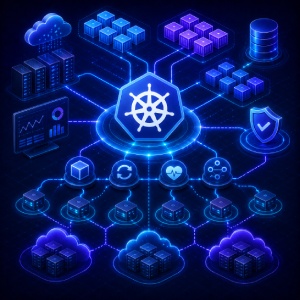
Improved management of a high volume of containers deployed in widely-distributed environments needed to be addressed as these containers proliferated. One platform that came into existence in this regard is Kubernetes.
Kubernetes automates a lot of operational tasks as part of managing containers. Helps to schedule workloads, scales, monitor application health and distribute traffic to services.
In big businesses, they have thousands of containers running at once. It would be impractical the number of times this decision will have to be made by hand. Kubernetes gives a standardized approach to efficiently manage distributed workloads.
The site also enhances resiliency. Kubernetes can take care of rolling back any workloads that are down or restarting if containers fail or become overloaded, and shift traffic away from failed workloads without having to take any manual action.
By facilitating gradual deployment in a Kubernetes environment while ensuring applications remain available, you can implement continuous deployment practices. This will help minimize downtime at software release times and infrastructure changes.
Kubernetes is rapidly becoming an integral part of enterprise infrastructure management with the growing adoption of cloud-native applications.
Application of Automation and Operational Efficiency Within Infrastructure Applications
Through infrastructure automation, organisations can achieve automation by programmatically creating systems instead of programmatic configuration steps. Infrastructure-as-code tools allow a team to build, update, and reproduce the environment, in a consistent fashion, across multiple regions and cloud service providers.
Automation eliminates manual execution mistakes due to predefined templates and policies in the environment. It also enhances speed because they will scale up or down automatically depending on the workload
These are several practices that are considered as automation:
- Environments can be deployed and managed with repeatable configuration files with infrastructure as code frameworks.
- Automated scaling systems vary infrastructure resources in response to the needs of traffic and workload.
- Rapid software updates with minimal manual effort are made possible by Continuous integration and deployment pipelines.
- Policy automation aids in ensuring security and compliance measures are robustly enforced across environments.
- Operational anomalies are detected by automated monitoring systems, which then initiate responses based on predefined instructions.
These capabilities enhance consistency of operations and minimize the need for repetitive manual tasks.
Cloud-Native Scalability & Resilience

One of the major reasons for enterprises to choose cloud-native infrastructure is that it’s scalable. Today’s digital service needs to accommodate the evolution of job loads, seasonal commodity demand, and world-wide users.
The amount of resources organisations had to provision ahead of time in order to ready themselves for traffic spikes was often large, with traditional systems. With cloud-native systems, resources can grow or shrink as they are needed at a given moment.
Applications can scale up and scale down resources to alleviate peak times during busy periods and lower resource consumption during periods of underutilization.Applications can scale-up and scale-down resources to alleviate peak times when there’s higher traffic and scale down the resources when there’s lower traffic load. This enhances the performance and cost efficiency.
In addition, the cloud-native environment is resilient. Distributed architectures decrease reliance on single servers or areas. Workloads can typically go on running with the failover services or through alternative regions if a single service fails.
Whether you’re running a critical application that demands high availability and downtime avoidance, Bank of America’s resilience is important.
The Operational Impact on Enterprise Teams
Adopting cloud-native alters enterprise team dynamics. Infrastructure management is not only located within the operating silos of companies’ operations departments dealing with physical hardware. The development and operations teams are gaining closer collaboration and integration in their processes.There is growing collaboration and integration of development and ops teams in the development process.
This is commonly known as the DevOps model. DevOps fostered a culture that makes it easier for software development and infrastructure and security teams to work together to make deployments faster and more reliable.
The teams need to build up their technical skills to be able to build on cloud-native systems. Engineers can be building apps, working on automation, deployment of containers and similar cloud observability, as well as infrastructure management.
The need for operational visibility also increases. A large volume of telemetry data is generated by distributed systems; it is a critical requirement that the data needs continuous monitoring. Observability platforms enable teams to monitor users behaviour, application performance and infrastructure health in different environments.
Challenges in Cloud Native Infrastructure
Cloud-native technology is all about agility, scalability, but it does create new security risks. Distributed apps have many interdependent services, APIs and containers to use, which makes them have more attackable surface area.
Operational security of the container gained importance. If vulnerabilities are not identified in the image before the environment, they can spread like wildfire.
Distributed systems require more complicated identity and access management. Everything from apps to services to automated processes needs access to infrastructure resources that they must control.
Security practices are moving towards embedding protection in development and deployment pipelines.Security practices are now aimed at embedding protection in development and deployment pipelines. This is known as DevSecOps.
Automated vulnerability scanning, workload segmentation, encryption, and ongoing compliance monitoring are just a few examples of cloud-native security strategies.
Observability in a Distributed Environment
The traditional monitoring systems do not often have the necessary resources to handle the vast amounts of operational data generated by distributed applications in cloud-native systems.
Observability platforms offer applications visibility of their behaviour using metrics, logs, traces and infrastructure events. These systems enable the operational team to detect performance problems, analyze occurrences and improve work-loads.
It becomes crucial to enable distributed tracing in microservices applications. Tracing enables teams to benchmark requests as they traverse infrastructure components, depending on the number of interconnected services.
Real-time observability has a positive impact on incident response by enabling teams to proactively detect operation issues before impacting a great number of customers.
Observability has emerged as a fundamental use case for infrastructure, but one that was previously considered an afterthought.
Cloud Native Deployments of Hybrid and Multi-Cloud
A lot of companies manage cloud native systems in hybrid and multi-cloud environments instead of using a single cloud provider. Everything from public cloud to private infrastructure and to edge environments can be involved in applications.
This offers flexibility and helps to lower reliance on specific vendors. It also makes operations more complex, however.
Standards of deployment are hard to achieve in various environments. Networking, security policies and observability systems need to work together while keeping infrastructure differences in mind.
One of the challenges that containerisation and orchestration platforms are helping to solve is that they offer standardised deployment models to providers. Therefore, multi-cloud cloud-native systems are sure to gain popularity as resilience and flexibility become a key priority for organisations.
The Business Drivers Behind Cloud-Native Adoption

Technical trends aren’t the only driving force for cloud-native transformation. The adoption of enterprises is also significantly influenced by business priorities.
Faster development cycles, higher service availability, and more flexibility in operation are desired by organisations. Here, cloud-based infrastructure can help them achieve these objectives by minimizing friction in deployment and allowing for more rapid iteration.
Digital competition has also helped to drive adoption. Companies are relying on the quality and responsiveness of digital services more and more to compete. The slow cycle and inflexible infrastructure may restrict innovation.
Another significant one is operational efficiency. As workloads increase, automation and scalable infrastructure serve as a solution to managing them while maintaining the same proportionate cost.
Additionally, cloud-native systems offer more flexibility and scalability to support remote operations and global expansion compared to traditional infrastructure models.
Cloud Native Infrastructure of the Future
The necessary enhancements in cloud-native systems will undoubtedly persist as enterprise technology environments get more widespread and data-driven. Auto, AI and edge are expected to be further embedded in cloud-native operations.
There is a possibility that serverless computing may grow even more. Such systems enable organisations to run workloads in a way that does not require them to manage infrastructure resources directly, further abstracting the operations.
New emerging trends are included in platform engineering. Platform teams deliver standardised internal systems to ease the movement of cloud-native operations, as opposed to each development team needing to manage their own infrastructure.
Sustainability can also be a factor in infrastructure design. Businesses are starting to consider on top of performance and scalability, how efficient infrastructure can be.
Given their cloud-native nature, it seems that operational priorities will increase to bring down the friction and drive towards being flexible and resilient.
Cloud-Native Infrastructure as the Next Enterprise Standard
Businesses are resourcing their cloud-native infrastructure due to the need for a different approach to meet the current digital needs.
Adopting a cloud-native approach will alter the entire team experience, application security and infrastructure management. The progress of enterprise environments has continually changed throughout the years, and cloud native systems are expected to continue playing a key role in digital transformation strategies.